
Community-Led Pathways for Affordable and Resilient Housing
Safe, comfortable, and affordable housing is essential to the well-being of every community. In northern regions such as Chisasibi, however, many homes face ongoing challenges related to overcrowding, aging infrastructure, high energy costs, and the impacts of harsh weather. These conditions can contribute to issues such as mold, poor indoor air quality, and increased maintenance costs, highlighting the need for housing solutions that are designed specifically for northern environments.

Last week, community members, researchers, and project partners gathered in Chisasibi as part of the Community-Led Pathways for Affordable and Resilient Housing initiative. The workshop created an opportunity to share knowledge, discuss local housing priorities, and explore innovative approaches to creating healthier, more energy-efficient, and culturally appropriate homes for the future.

This collaborative project brings together the Cree Nation of Chisasibi (CNC), the Chisasibi Eeyou Resource and Research Institute (CERRI), Concordia University, and the Volt-Age Living Lab. By combining community knowledge with research and technical expertise, the partnership aims to develop housing solutions that are not only affordable and resilient but also reflect the unique needs, values, and priorities of the Chisasibi community.
Community engagement is at the heart of the project. Throughout the workshop, participants emphasized that residents are the experts on the homes they live in every day. The experiences shared by families, Elders, youth, and other community members help shape future research and ensure that proposed solutions reflect local realities rather than one-size-fits-all approaches.

The project also follows a collaborative framework that brings together researchers, community leaders, builders, and residents. Research is organized into several focus areas, including assessing existing housing conditions, exploring prefabricated construction methods, developing digital twin models, improving energy efficiency through electrification, evaluating long-term affordability, strengthening climate resilience, and gathering ongoing community feedback. Together, these efforts support practical solutions that can improve housing while building local capacity for future generations.
Building Healthier Homes

One of the workshop presentations focused on an often-overlooked part of every home—the building envelope. This includes the walls, roof, foundation, insulation, windows, and air barriers that separate the indoor living space from the outdoor environment.
For northern communities, a high-performance building envelope is essential. Proper insulation, airtight construction, moisture control, quality ventilation, and high-performance windows all work together to reduce heat loss, prevent mold and condensation, improve indoor air quality, and lower energy costs. These improvements not only create healthier homes but also increase comfort and reduce maintenance over the long term.
The presentation demonstrated how thoughtful building design can make homes more resilient to northern climates while improving the overall quality of life for residents.
Improving Energy Efficiency in Northern Housing

Another presentation explored how upgrading existing homes can significantly reduce energy use while improving comfort for families.
Using a typical northern home as an example, researchers demonstrated how improvements such as better insulation, airtight construction, heat pumps, efficient hot water systems, and renewable energy technologies can dramatically reduce household energy demands. Their research showed that combining these upgrades could reduce annual energy consumption by up to 57% while lowering heating demand by 69%.
For communities where heating costs are high and winters are long, these improvements have the potential to reduce monthly expenses, improve indoor comfort, and strengthen resilience during extreme weather, all while lowering environmental impacts.
Exploring Prefabricated Housing Solutions
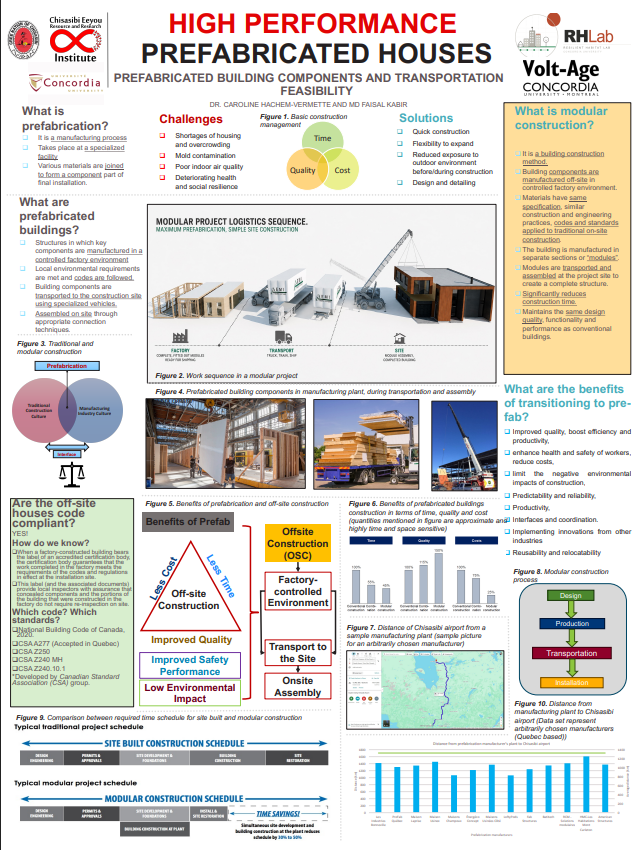
Participants also learned about the growing potential of high-performance prefabricated housing as one approach to addressing northern housing challenges.
Unlike traditional construction, prefabricated homes are built in controlled manufacturing facilities before being transported and assembled on-site. This process can improve construction quality, reduce weather-related delays, shorten construction timelines, enhance worker safety, and lower environmental impacts.
The presentation also examined transportation logistics, Canadian building standards, and how modular housing could provide flexible, durable, and energy-efficient homes that meet the unique needs of communities like Chisasibi. While every community has different priorities, prefabricated construction represents one option that could help address housing shortages while maintaining high quality and performance.
Looking Ahead
The Community-Led Pathways for Affordable and Resilient Housing initiative is about much more than constructing new buildings. It is about creating healthier homes, improving quality of life, reducing energy costs, and ensuring that future housing reflects the voices and priorities of the people who live in the community.

Through strong partnerships between the Cree Nation of Chisasibi, CERRI, Concordia University, the Volt-Age Living Lab, and community members, this initiative is helping build a future where housing solutions are informed by local knowledge, guided by collaboration, and supported by research and innovation.
As the project moves forward, the knowledge gained through community engagement and ongoing research will help shape practical housing solutions for Chisasibi while contributing valuable insights that may benefit other northern and Indigenous communities facing similar challenges.


Comments